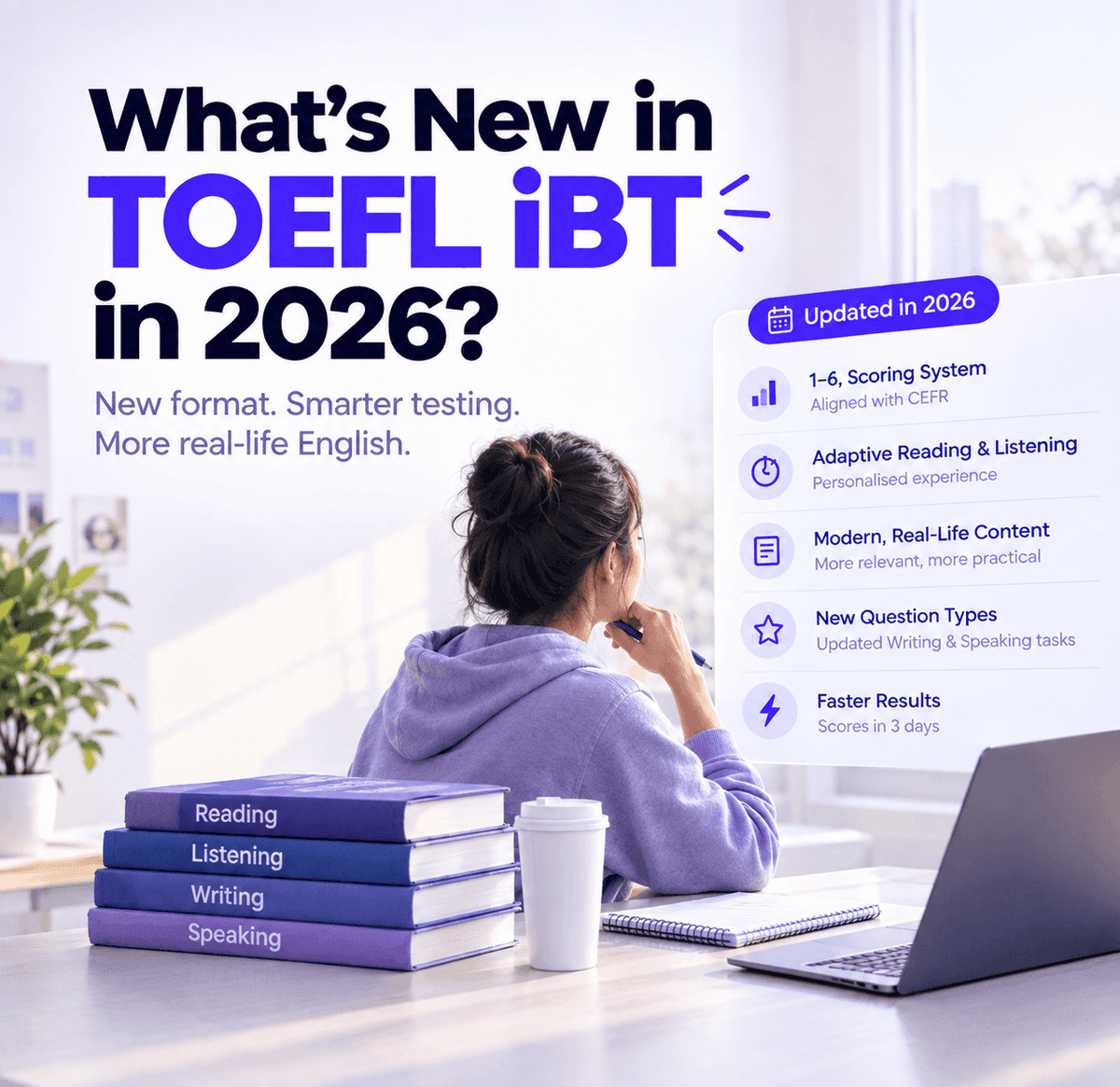
If you are planning to take the TOEFL iBT in 2026, you should prepare for a significantly updated test experience. The revised TOEFL iBT was introduced worldwide on January 21, 2026, with changes to scoring, Reading, and Listening question types, test content, and score reporting.
The four sections remain Reading, Listening, Speaking, and Writing, but the test now uses a new 1–6 scoring scale, adaptive Reading and Listening sections, and task formats designed around academic and student-life communication.
One of the biggest changes is the introduction of a 1–6 scoring scale, reported in half-point increments. The scale is aligned with the Common European Framework of Reference for Languages, or CEFR, making English proficiency easier to interpret internationally.
You will receive:
The overall score is calculated by averaging the four section scores and rounding the result to the nearest half point. For example, if the average of the four section scores is 5.25, the reported overall score is 5.5.
The transition period
There is a two-year transition period after the January 2026 update. Through January 2028, score reports will include the new 1–6 scores and a comparable overall score on the former 0–120 scale.
Universities may update their admission requirements at different times. Some institutions may still display 0–120 requirements, while others may publish 1–6 requirements or both during this transition period. Always check the current requirements directly with the university you are applying to.
Reading and Listening now use a multistage adaptive design. This means that later stages of these sections can reflect how you performed in earlier stages.
The adaptive format means that the exact number of questions and timing can vary. Students should therefore prepare for a range of difficulty levels rather than relying on a fixed question sequence.
Effective preparation should focus on:
Adaptive testing does not mean that students can predict their score from one difficult or easy question. The best strategy is to answer each task carefully and continue working consistently.
The updated TOEFL iBT includes a more modern combination of academic content and real-life campus situations.
ETS has introduced reading material inspired by modern sources such as magazines and websites. Listening tasks can include situations that students may encounter in academic and campus life, including conversations, announcements, and academic talks.
The updated Reading tasks include:
The updated Listening tasks include:
This does not mean that the test has become informal or less academic. You still need strong comprehension, vocabulary, grammar, and communication skills, but the contexts may feel more familiar and connected to modern student life.
The four sections remain the same, but the tasks within them have changed.
The Writing section now includes:
These tasks require students to demonstrate sentence control, appropriate tone, organisation, clarity, and the ability to communicate ideas in academic or student-life contexts.
The Speaking section now includes:
These tasks assess your ability to understand spoken English, respond clearly, and communicate effectively in realistic situations.
Reading and Listening
Reading and Listening also use updated task formats, including daily-life texts, academic passages, conversations, announcements, and academic talks.
Because the task types are different from older TOEFL formats, students should confirm that their preparation materials reflect the post-January 21, 2026 test.
The full TOEFL iBT experience is designed to take approximately two hours, although the exact timing and number of questions may vary because Reading and Listening are adaptive.
ETS says scores are expected to be available in your ETS account three days after your test date. The expected score-availability date is displayed at the end of the test, and ETS also sends an email when scores are ready.[ets] Students should still check the score-reporting timeline carefully, especially when working with university or visa deadlines.
Updated TOEFL iBT structure
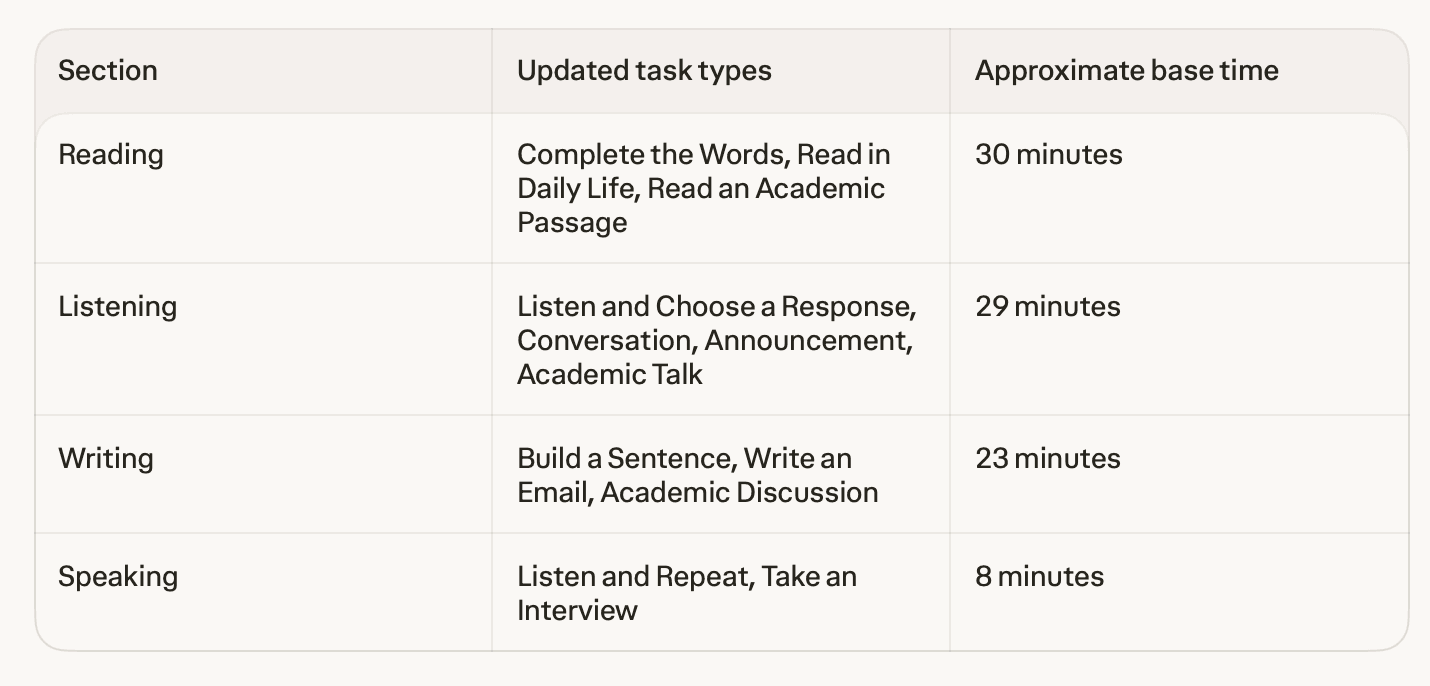
The test time does not include directions, and the exact experience may vary because of the adaptive format.
What do the changes mean for students?
The 2026 TOEFL update is more than a change from a 0–120 score to a 1–6 score. It also changes the way students prepare for Reading, Listening, Speaking, and Writing.
If you are preparing for the updated TOEFL iBT:
A strong preparation plan should combine test awareness with genuine English development. Memorising templates alone is unlikely to prepare you for the range of updated tasks.
How PACE can help
Preparing for the updated TOEFL iBT requires more than memorising question patterns. At PACE, learners receive personalised support across Reading, Listening, Speaking, and Writing, with preparation aligned to the updated task types and scoring system.
A personalised assessment can help identify:
Whether you are starting TOEFL preparation or moving from older preparation materials to the new format, PACE can help you understand what to practise and how to improve.
Ready to prepare for the updated TOEFL iBT? Book a free English assessment with PACE.
Final thoughts
The 2026 TOEFL iBT introduces a new 1–6 scoring system, adaptive Reading and Listening sections, updated task types, modernised content, and faster score reporting. The best way to prepare is to understand the new format early and practise with current resources. Focus on the complete range of English skills, not only memorised answers or older question patterns.
With the right preparation and a clear understanding of the updated test, you can approach the TOEFL iBT with greater confidence and demonstrate your English ability more effectively.
Official sources For the latest requirements, test structure, score information, and university policies, consult the official ETS TOEFL website and the admissions page of each university you are applying to.
Book a free 25-minute trial session with our expert teachers and experience personalized English learning.